Usable with a weak hand
Large targets, as little typing as possible. Nearly every field accepts voice, and the things you log daily take a single tap. The benchmark is a hand that doesn't fully work.
DASISEOGI · RECOVERY RECORD
After a serious illness, daily life doesn’t simply come back. What did I do yesterday? Did I take my medication? How is my body today? There had to be somewhere that held all of it.
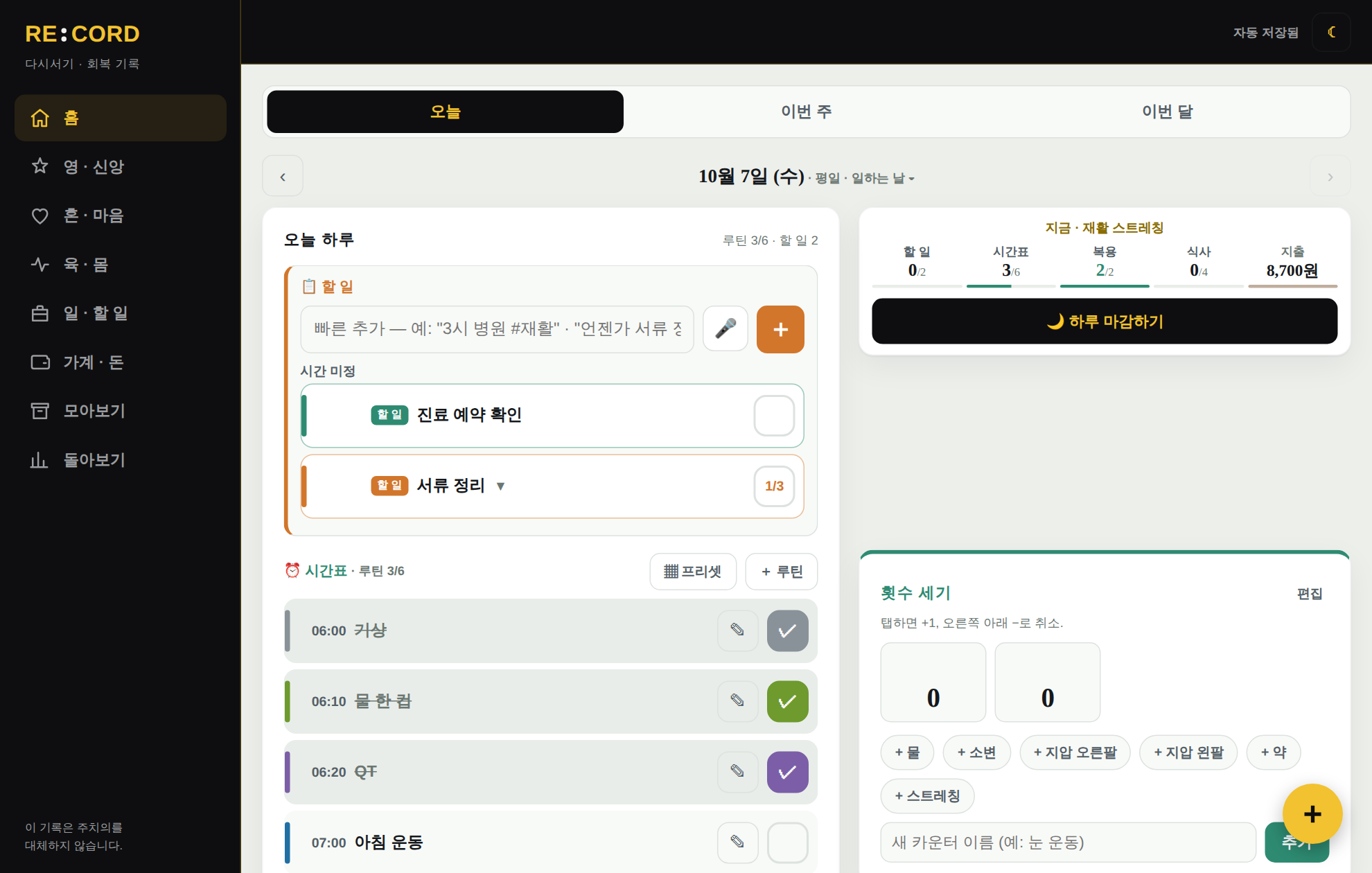
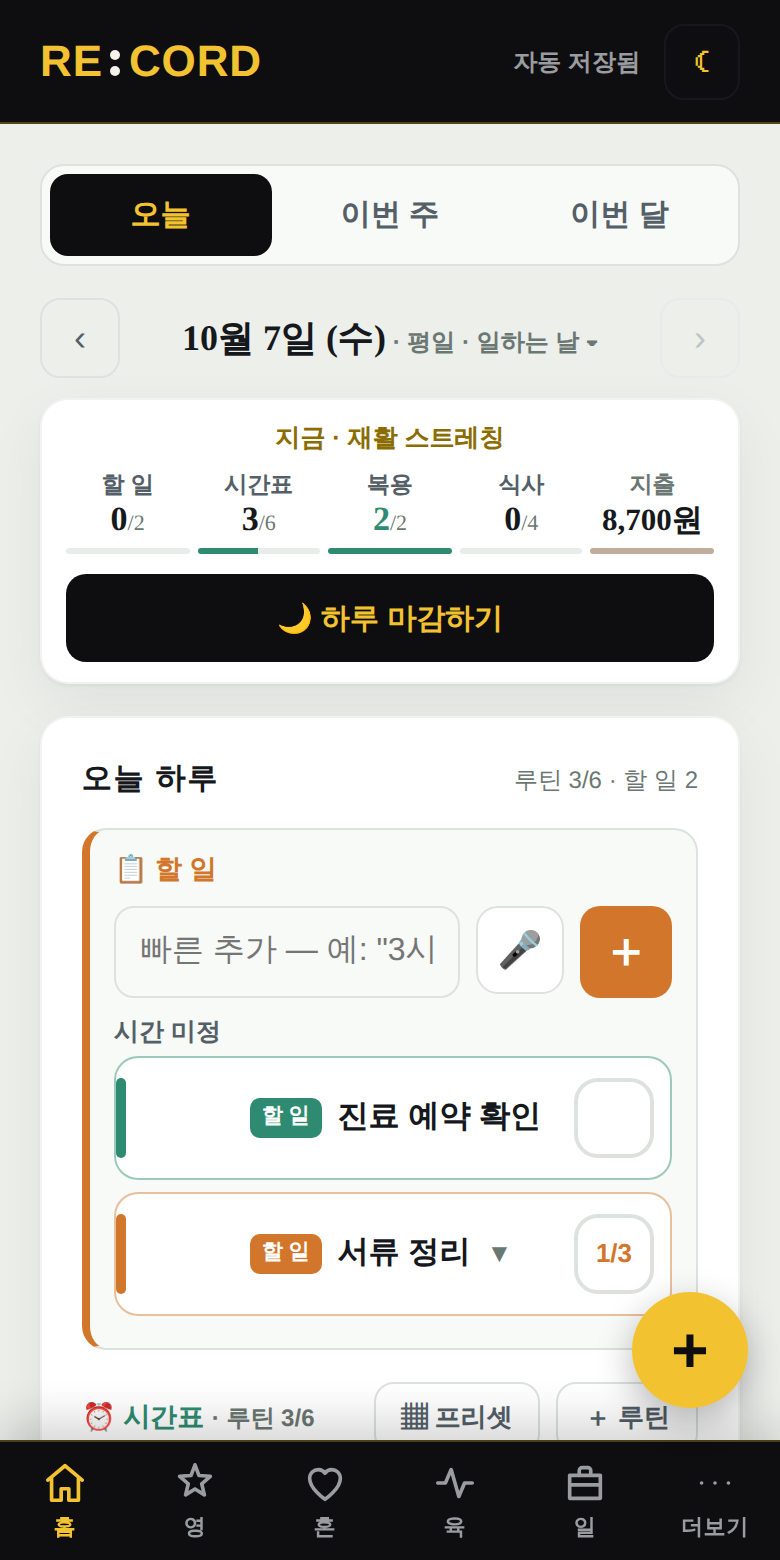
RE:CORD brings four areas — spirit, mind, body and work — onto one screen: a recovery planner you can actually keep up with.
다시서기 (dasiseogi) — Korean for standing up again. · The app is currently in Korean.
WHY IT EXISTS
After a rare chronic illness put me in a hospital bed, my days came apart. My hand lost its grip, so writing was hard. I couldn’t remember whether I’d taken yesterday’s medication. In the exam room, when the doctor asked “how have you been?”, I had nothing to say.
There were good apps. But they tracked the body, or the to-do list. Recovery didn’t arrive that way. It meant praying, steadying my mind, doing rehab — and still earning a living. It was the work of a whole day.
So I built the thing I needed. I used it every day and fixed whatever got in the way that same day. Buttons too small? Made them bigger. Typing too hard? Added voice. RE:CORD didn’t come out of a spec document — it was shaped day by day by a hand that doesn’t fully work.
— the maker of Dasiseogi
THREE PROMISES
Large targets, as little typing as possible. Nearly every field accepts voice, and the things you log daily take a single tap. The benchmark is a hand that doesn't fully work.
Plenty of apps track the body, or the to-do list. Recovery doesn't move in one lane. Spirit, mind, body and work sit on one screen, so you can see where the day actually stands.
What you log turns into words in the exam room. Thirty days of numbers, how often symptoms appeared, doses missed — gathered into a draft you can bring to your doctor.
FEATURES
Tasks, schedule, medication, meals, prayer and spending — one line each. The app highlights where you are in the day.
Turn routines into cards ordered by time. Days that run differently — a Sunday, a day out — load as a saved preset.
Add with one plain sentence, break work into steps. A weekly wizard clears what slipped before you plan the next week.
Carry prayer requests daily, keep quiet-time and sermon notes. An AI study guide is built in.
Three lines of gratitude, an end-of-day journal, a place for today's writing. Every field takes voice input.
Sleep and condition numbers, medication checks with 30-day history, meal logs — and a draft summary before a doctor's visit.
Type an amount, tap a category, done. You see what's left this month and what you can spend today.
Stored in your own account, exportable to a file any time, restorable on another device.
AI
Give it a passage and it writes a guide that moves from observation to reflection to application — with a field under every question, so it becomes your own notebook.
Sleep, condition, medication, meals and routines from that day, gathered into a summary that points out what stands out — plus questions worth raising with your doctor.
Photograph what you ate and the entry fills itself in. One less thing to type.
AI here organizes and reflects back what you recorded. It does not diagnose, and it does not recommend treatment. Decisions about medication belong with your doctor.
PRICING
₩0
TBA
COMMITMENTS
RE:CORD is a record-keeping tool. It does not diagnose, prescribe or decide treatment, and it is not a substitute for your doctor. If something looks dangerous, the hospital comes before the record.
They open only in your own account, and you can download everything as a file at any time or restore it on another device. We do not use records for advertising.
This began as one person’s recovery. Before any trend-chasing feature, it has to be solid enough to open on a bad day.
It doesn’t have to be a grand beginning. The time you woke up. One pill you took. Those single lines add up into a record of getting better.